Is Matchmaking Worth It? An Honest Cost-Benefit Breakdown


You're not really asking if it works. You're asking if it's worth it for you.
For the right person, matchmaking is worth it: it trades money you have for time you don't, and replaces the grind of self-managed dating with hand-selected, compatibility-screened introductions. It's worth it if you're genuinely ready for a serious relationship and your time is valuable. It's not worth it if you want a guaranteed outcome or expect to stay passive. At VIDA, 82% of clients meet someone special within 90 days.
Bottom line: Matchmaking is worth it if you are ready for a serious relationship and short on the time to find one, and VIDA Select is built for that case: a dedicated matchmaker, hand-selected introductions, and no blind dates.
Table of contents
You're not really asking if it works. You're asking if it's worth it for you.
For the right person, matchmaking is worth it: it trades money you have for time you don't, and replaces the grind of self-managed dating with hand-selected, compatibility-screened introductions. It's worth it if you're genuinely ready for a serious relationship and your time is valuable. It's not worth it if you want a guaranteed outcome or expect to stay passive. At VIDA, 82% of clients meet someone special within 90 days.
Bottom line: Matchmaking is worth it if you are ready for a serious relationship and short on the time to find one, and VIDA Select is built for that case: a dedicated matchmaker, hand-selected introductions, and no blind dates.
Key Takeaways:
- Matchmaking is worth it for people who are ready to commit, value their time, and want introductions handled for them; it is not worth it for passive participants or anyone expecting a guaranteed relationship.
- Professional matchmaking in the U.S. ranges from roughly $1,695/month on the accessible end to $100,000+ for high-end retainer firms. VIDA operates month-to-month rather than on large upfront contracts.
- The real product is time saved and emotional load reduced, not just dates. Serious self-managed dating can consume 500+ hours a year.
- Reputable services screen and hand-select matches; they do not guarantee a relationship outcome. Any service promising guaranteed marriage is a red flag.
- Contract structure is the biggest hidden risk. Large upfront, multi-month contracts with no refund are where most “was it worth it” regret comes from.
Most people asking this question have already tried the alternative. They've spent months on the apps. They've had the string of first dates that went nowhere. They've reached the point where leaving something this important to an algorithm stopped feeling smart.
So the question isn't really whether matchmaking works for anyone. It's whether it's worth the investment for someone in your position, with your time, your standards, and your goals.
Here's the honest answer, including who it's genuinely not right for, what it actually costs, and how to tell a reputable service from one that will take your money and leave you waiting.
Disclaimer: This guide was researched and written by VIDA Select's editorial team to help singles determine whether matchmaking is the right strategy for their needs and goals. As a matchmaking service ourselves, we bring a unique industry perspective. Our insights come from 17+ years of matchmaking experience, writing 200+ matchmaking service reviews, analyzing public information including reviews on reputable platforms, and feedback from clients who used other services before hiring VIDA.
The Better Question: Worth It Compared to What?
Most people do not compare matchmaking to doing nothing. They compare it to continuing to date the way they already have been: swiping, messaging, screening, scheduling, going on first dates that go nowhere, getting discouraged, taking breaks, then starting over again.
That comparison matters, because matchmaking is expensive in dollar terms, but DIY dating is often expensive in every other way. It costs time. It costs emotional energy. It costs attention. And if you are a busy, relationship-minded person, it can quietly drag on for years longer than you expected.
That is why the people who get the most value from matchmaking are usually not asking whether love should have a price tag. They are asking whether the way they are doing this now is working well enough to justify continuing.
When matchmaking tends to be worth it
1. You are spending a huge amount of time on dating already
This is one of the strongest arguments for matchmaking, and the one that tends to land hardest with people who have been at this for a while.
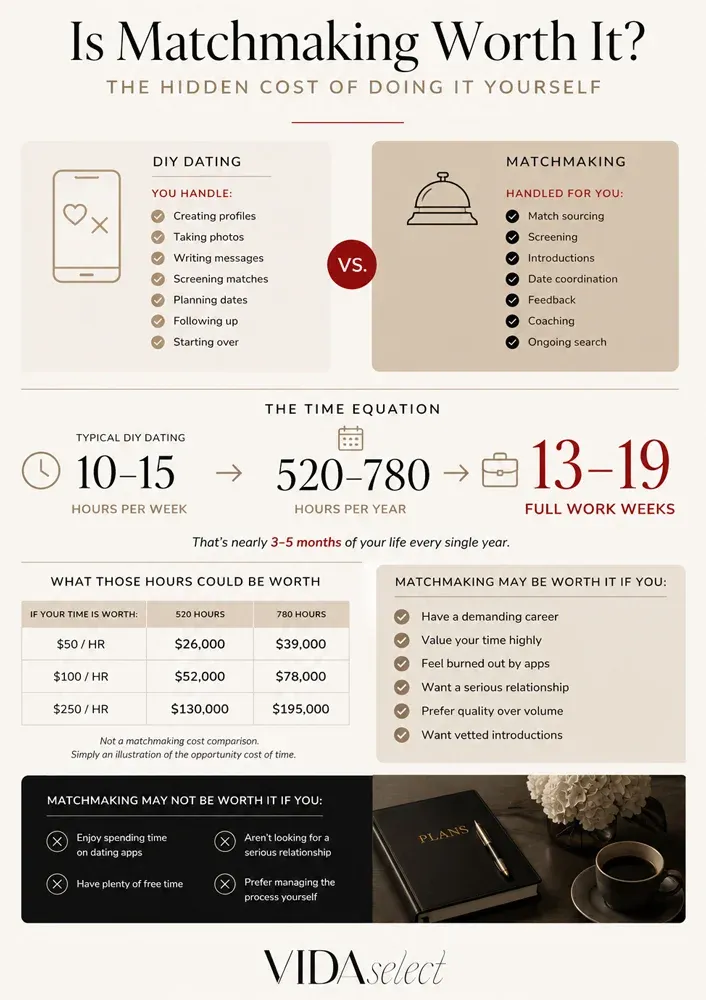
Serious dating can easily take 10 to 15 hours a week between profile management, screening, conversations, scheduling, first dates, and the constant mental overhead of staying engaged. Even when the dates themselves are fine, the process is inefficient.
A good matchmaker removes most of that burden. They handle the search, the screening, the outreach, and the logistics. You review the match, decide whether you want to meet, and show up for the date.
If your time has real economic value, the math often looks different once you account for what DIY dating is actually costing you. If you bill $200 an hour and you are spending 500-plus hours a year on dating, that is six figures of your time. A matchmaking service starting at $1,595 a month looks very different through that lens.
2. You want access to people outside the app ecosystem
Dating apps give you access to everyone who is on dating apps, which is a very large pool in metro areas. But it also excludes a meaningful segment of relationship-minded singles who have opted out of that experience entirely.
Some want more privacy. Some are too busy to manage the process themselves. Some are burned out and no longer using apps consistently. Others are simply not good at presenting themselves online, even though they may be excellent partners in real life.
The best matchmakers draw on multiple sources, including their own internal databases, professional matchmaking networks, dating platforms, and beyond. The practical effect is introductions with people you had no realistic path to meeting on your own. Your pool is no longer limited to who happens to swipe into your orbit.
3. You care more about fit than volume
The value of matchmaking is not that you go on more dates. It is that the dates are supposed to be better filtered.
Instead of sorting through a high volume of low-probability leads, you are paying for a process built around compatibility, lifestyle fit, relationship goals, and all the subtler factors that are hard to screen for in an app profile.
Dating app burnout is real. According to a Forbes Health survey, 78% of app users report feeling it (Forbes Health, 2025). The emotional toll of the swiping, ghosting, and repeated disappointment compounds over time. A smaller number of genuinely promising introductions is a qualitatively different experience, and one that tends to keep people more optimistic and engaged in the process.
4. You want a process that improves over time
Apps optimize for engagement, not outcomes. The more time you spend on them, the better they perform their actual job, which is keeping you on the app.
A matchmaker's incentive is different. After each introduction, your feedback shapes the next one. If a match was off on a specific dimension, that information carries forward. If you responded better than expected to a certain personality type or lifestyle fit, that becomes useful data too. Over time, the search narrows in on what you actually respond to, not just what you said you wanted at the outset, which are often different things.
Good matchmaking is not static. It gets more informed as it goes.
5. You want an expert in your corner
Dating on your own can be surprisingly isolating, especially if you are thoughtful, selective, and genuinely trying to build something long-term.
A strong matchmaker functions as an experienced advocate and sounding board. They have seen thousands of situations like yours. They can tell you when your criteria are working against you, when you are overlooking someone worth a second look, and when a pattern in your feedback suggests something worth examining.
That perspective, coming from someone genuinely invested in your outcome, is something you do not get from an app, a friend, or even a therapist who does not know the dating landscape. Sometimes what people are really paying for is not only access. It is clarity, momentum, and a process that feels less random.
What Matchmaking Is Worth Depends on the Service Model
This is where a lot of people go wrong. They ask whether matchmaking is worth it as if all matchmakers offer roughly the same thing. They do not.
There is enormous variation in price, process, accountability, search scope, and match quality. A great-fit service can absolutely feel worth the investment. A weak one can feel like a waste of money even if matchmaking, in theory, was the right strategy. The biggest differences:
| What to compare | The limiting version | The version worth paying for |
| Where matches come from | Closed internal database of existing clients | Active search across multiple sources, so the pool isn't capped by who already signed up |
| Seeing matches first | Blind dates or minimal info beforehand | Full profile and photos to approve before you meet |
| Commitment | Large upfront payment, 6–12 month contract | Month-to-month or short-term package, so the service has to keep earning it |
| Geographic reach | One city or region only | Broader search when your criteria call for it |
A limited candidate pool is the single most common reason people feel their matchmaker "wasn't worth it." Being matched with whoever was available, rather than who was actually compatible, is the complaint that shows up most across the industry.
Services that charge monthly also carry more structural incentive to keep performing, because you can leave.
For a deeper look at what to ask before signing with any service, see our guide to hiring a matchmaker.


How Much Does a Matchmaker Cost?
Matchmaking fees range from roughly $1,695/month to $100,000+ a year depending on the service and scope. The important thing isn't just the price, it's what the price buys.
| Tier | Typical Cost | What it usually includes |
| Accessible / modern | ~$1,595–$2,400 / month | Match sourcing from internal database + scouting on apps & social platforms, month-to-month flexibility |
| Mid-market boutique | ~$6,000–$25,000 (package) | Guaranteed intro counts, post-date feedback, regional search |
| High-end retainer | $25,000–$100,000+ | Nationwide recruiter-style search, very small client roster |
In broad terms: lower-priced services tend to offer more limited scope, often relying heavily on internal databases. Mid-tier services may provide more personalization and better filtering. High-end firms typically charge for wider search scope, white-glove service, multi-city reach, and a more labor-intensive process.
The important thing is not just what it costs. It is what you are getting for that cost. Two services with similar pricing can produce very different experiences depending on how they source matches, how responsive they are, how transparent they are, and how much control you have in the process.
For the full tier-by-tier breakdown, see our matchmaker pricing guide.
Is Hiring a Matchmaker a Scam? How to Spot a Reputable Service
Hiring a matchmaker is not a scam, but the industry is largely unregulated, so quality varies and some services are better at selling than at matching. A question behind "is it worth it" is usually "am I about to get taken." Here's how to tell.
Reputable matchmaking service: a service that screens and hand-selects compatible introductions, is transparent about process and pricing, and guarantees its work (hours, introductions) rather than guaranteeing a relationship outcome.
Green flags:
- Transparent pricing and a clear description of what the fee covers
- Process guarantees (number of introductions, service hours), not outcome guarantees
- Flexible terms, ideally month-to-month, rather than a large non-refundable upfront contract
- A verifiable track record and third-party reviews
Red flags:
- Any promise of a guaranteed marriage or having "your perfect match" within the database
- A large upfront payment for a long contract before any service begins, with no refund path
- High-pressure tactics or "we already have someone perfect for you" before they understand what you want
- Reluctance to answer directly where matches come from or how many clients your matchmaker carries

When matchmaking is not worth it
Matchmaking is not a good investment for everyone.
It tends not to be worth it if you are not genuinely ready for a relationship. Maybe you're still processing a breakup, unclear on what you want, or treating it as something to try while you figure things out. A matchmaker can put the right person in front of you, but they cannot make you ready to meet them.
It also tends not to work well when expectations are not realistic. If you are trying to meet someone significantly younger, or someone who earns far above your own income bracket, you are likely not going to get the outcome you want. A good matchmaker will help you set reasonable criteria based on what you bring to the table, and if you are unwilling to make those adjustments, the investment is not worth it given the likely result.
For a full breakdown of who probably should not hire a matchmaker, this post goes into the specific situations where it does not make sense.
So, is matchmaking worth it?
For many busy, relationship-minded singles, yes. If you are tired of spending huge amounts of time on dating, frustrated by the limits of app-based search, and ready for a more deliberate process, matchmaking can absolutely be worth the investment.
But the better takeaway is this: matchmaking can be worth it. Not every matchmaking service is. Once you know matchmaking itself makes sense for you, the next step is comparing service models, pricing structures, and search methods so you can find the right fit.
If you want a service with month-to-month flexibility, full profile and photo visibility before every introduction, and a proactive search that goes beyond a closed internal database, VIDA Select is worth a look. 82% of VIDA clients meet someone special within 90 days, typically after 4 to 6 introductions.
The free consultation is a no-commitment way to find out if it is a fit. Answer a few questions below, and if you qualify you will be immediately invited to schedule at your convenience.


Frequently Asked Questions
Does matchmaking actually work?
Does matchmaking actually work?
Yes, for people who are ready for a relationship and willing to take introductions seriously. VIDA Select reports that 82% of clients meet someone special within 90 days, typically after 4 to 6 introductions. Matchmaking works by replacing volume with screening: rather than sorting through candidates yourself, someone screens for compatibility first and you meet only the people worth meeting. Matchmaking does not work for people who aren't ready to commit the time to actually go on dates. No reputable service can guarantee a relationship, and any that does is worth walking away from.
What is the success rate of matchmaking services?
What is the success rate of matchmaking services?
Success rates vary significantly by service and depend heavily on how "success" is defined, which is worth asking about directly before signing with anyone. Some services count a match when they present you with a profile, whether or not you agree to meet. Others only count it when a date actually takes place. VIDA Select, for instance, reports that 82% of clients meet someone special within 90 days, typically within 4 to 6 curated introductions. Reputable matchmakers should be transparent about their track record and willing to define exactly what their success rate measures.
Is matchmaking better than dating apps?
Is matchmaking better than dating apps?
For people who are serious about finding a relationship and have been struggling on apps, matchmaking tends to deliver better outcomes, but for different reasons than most people expect. The main advantages aren't that matchmakers have access to a secret pool of singles unavailable on apps. It's that they handle the entire process on your behalf, apply trained judgment to compatibility rather than leaving it to an algorithm, and run a feedback loop that improves over time. Apps optimize for engagement. A matchmaker optimizes for your outcome. That structural difference matters more than most people realize going in. For a full comparison, check out our matchmaker vs dating apps guide.
How much does matchmaking cost?
How much does matchmaking cost?
Matchmaking fees range from roughly $1,695 to well over $100,000 depending on the service, scope, and how actively they search on your behalf. Month-to-month services like VIDA Select start at $1,695/month with no long-term contract. Traditional boutique and elite matchmakers typically require full upfront payment for contracts spanning 6 to 12 months or more, with fees ranging from $10,000 to $300,000+. Generally, the more affordable services match from an internal database, while higher-priced services conduct active, proactive searches across a broader range of sources. For a full breakdown of pricing tiers and what you get at each level, see our matchmaker pricing guide.
How long does it take to find someone through a matchmaker?
How long does it take to find someone through a matchmaker?
Timelines vary depending on the specificity of your criteria, your location, and the size of the service's singles pool. Services with broader reach, like those that search beyond a closed internal database, tend to produce results more quickly because they're not limited to who happens to already be in their system. At VIDA Select, 82% of clients meet someone special within 90 days, typically after 4 to 6 introductions.
What are the pros and cons of hiring a matchmaker?
What are the pros and cons of hiring a matchmaker?
The main advantages are time and screening. VIDA Select clients save countless hours a year compared to self-managed dating, and every match is screened for compatibility before it reaches them. Clients also review full profiles before agreeing to meet anyone, and a good matchmaker gives honest feedback that friends usually won't. The drawbacks: matchmaking costs significantly more than dating on your own, results depend heavily on how clearly you can describe what you want, and no service can guarantee a relationship. Long upfront contracts are the biggest risk in this industry, which is one of the reasons why VIDA Select offers month to month packages.
Who is matchmaking not worth it for?
Who is matchmaking not worth it for?
Matchmaking tends not to be a good investment if you're not genuinely ready for a relationship — still processing a breakup, unclear on what you want, or treating it as something to try while you figure things out. A matchmaker can put the right person in front of you, but they can't make you ready to meet them. It also tends not to work well when expectations aren't realistic. If your criteria aren't aligned with what you realistically bring to a relationship, no matchmaker can overcome that gap. For a full breakdown of the specific situations where matchmaking doesn't make sense, see this post on who shouldn't hire a matchmaker.
Should I hire a matchmaker?
Should I hire a matchmaker?
Hire a matchmaker if you're ready for a relationship, your time is worth more than the hours self-managed dating takes, and you'd rather someone else handled the searching and scheduling. VIDA Select works with professionals, typically in their 40s to 60s, and 82% meet someone special within 90 days. Skip it if you enjoy the process of dating on your own, if you're not ready to make time for introductions, or if the cost isn't comfortable for you.


![How Much Does A Matchmaker Cost? [2026 Price Comparison]](/_next/image?url=https%3A%2F%2Fgiving-darling-b92a0458a3.media.strapiapp.com%2FMatchmakers_cost_featured_c438ec928d.webp&w=3840&q=75)
![How To Hire The Best Matchmaker [Insider's Tips!]](/_next/image?url=https%3A%2F%2Fgiving-darling-b92a0458a3.media.strapiapp.com%2Fbest_mm_hero_c13d42785c.webp&w=3840&q=75)