Is Online Dating Safe? Essential Tips From VIDA's Dating Experts!


What To Know About Online Dating In 2026
Online dating can be safe, but you need to know what to watch for. Romance scams, fake profiles, and catfishing are real risks, and millions of Americans are targeted every year. The good news: a few smart habits can dramatically reduce your exposure and make your experience far more secure.
Table of contents
What To Know About Online Dating In 2026
Online dating can be safe, but you need to know what to watch for. Romance scams, fake profiles, and catfishing are real risks, and millions of Americans are targeted every year. The good news: a few smart habits can dramatically reduce your exposure and make your experience far more secure.
Key Takeaways:
- Romance scams are the most common consumer fraud in the US, with victims losing hundreds of thousands (and sometimes millions) of dollars to scammers
- Roughly 81% of online daters misrepresent themselves in their profiles; approximately 30% of Tinder users are reportedly married
- A reverse image search takes seconds and is one of the fastest ways to flag a fake profile
- Paid dating sites typically have fewer fake accounts than free platforms
- First date safety rules like meeting in public, controlling your own transportation, and leaving a paper trail are non-negotiable
The Upside — and the Very Real Downside
Online dating has been the dominant way couples meet for awhile now Since 2018, it's been the #1 way newlyweds connected, and roughly 1 in 2 American singles have created a profile. The appeal is obvious: you can dramatically expand your dating network beyond your social and professional circles, and meet people you'd never encounter otherwise.
But popularity has a dark side. One study found approximately 81% of online daters misrepresent their age, weight, or height. Another reported that 30% of singles on Tinder are actually married. And then there are the outright criminals: romance scammers who use dating platforms as their hunting ground.
The question isn't whether risks exist. They do. The question is how to protect yourself while still taking advantage of everything online dating has to offer.
Tip #1 - Recognize The Warnings Signs Of A Romance Scammer
Scammers are out there, and unfortunately dating sites and apps make for a target-rich environment.
In the US, romance scam victims reported losses of over $737 million to the FBI, and that’s in a single year.
Romance scams are now the most common type of consumer fraud in the United States.
According to the FBI, internet scammers who fish for targets on dating sites often target women who are recently divorced or widowed. In other words - emotionally vulnerable.
Most often those victims are both educated and computer literate. And yet they’re still taken, often for hundreds of thousands of dollars. In the last three years, victims in the US and Canada who came forward reported losing nearly $1 billion collectively. And that’s just the people who were willing to admit they’d fallen for a scam.
As Steven Baker of the Federal Trade Commission told the New York Times, “I don’t think there is a general understanding of how much of this romance scam stuff is out there, how it works and what the consequences are. It’s staggering how many people fall for it.”
How Romance Scammers Operate: The 4-Step Formula
Once you understand how scammers work, they're much easier to spot.
Step #1: Acquire a target.
Scammers troll dating sites and social media (especially Facebook) looking for potential victims.
Step #2: Build trust.
He'll mirror your interests, bond over "shared" experiences pulled from your profile, and make you feel genuinely understood. It can absolutely feel real, because he's skilled at making it feel that way.
Step #3: Dangle the carrot.
He'll suggest meeting in person, then always have a reason to cancel. The excuses are plausible and sympathetic: he's a soldier stationed abroad, a contractor working overseas, a doctor on a humanitarian mission.
Step #4: Ask for money.
It often starts small: a plane ticket, a medical emergency, an unexpected legal fee. Once you send once, the requests escalate — and never stop.
Many scammers are invested in a long con, spending months or even years cultivating a relationship before the financial asks begin. Forewarned is forearmed.
Real Victim Quotes — and the Red Flags Behind Them
The following are real quotes from victims who came forward to the FBI or other government agencies:
He was trying to finish up a job in California, and he needed some money to help finish the job. I thought about it long and hard. I prayed about it. I’ve always been a very giving person, and I figured if I had money … I could send him some. And he promised to have it back within 24 to 48 hours. I thought, ‘I could do that.’ It was kind of a statement of faith, too.
🚩Red Flag:
He claims to be working in a high-travel field (construction, military, oil rig, medicine) that makes in-person meetings impossible — and suddenly needs money urgently. The woman quoted above lost $30,000.
He was saying all the right things. He was interested in me. He was interested in getting to know me better. He was very positive, and I felt like there was a real connection there.
🚩Red Flag:
He seems like the perfect catch but consistently can't meet in person. If someone has been making excuses for weeks, move on. The woman quoted here eventually lost $2 million over several years.
Almost every day I was contacted with a new demand for money. They sent me certificates signed by officials, forms to fill out and bills for everything. If you wanted to get anything done quickly you had to pay another fee. It seemed to me that the whole Malaysian government was corrupt. I don’t know exactly how much money I sent but it was well over $100,000. I didn’t care about the money. I just wanted to help Jim and I honestly thought he would pay me back.
🚩Red Flag:
The requests never stop. If you send money once, you'll be asked again and again, with increasingly urgent stories. No matter how convincing the story, if you haven't met someone in person, don't send money.
A quick gut-check: If your best friend or adult child told you they were considering sending money to someone they'd never met in person, what would you tell them?
More Red Flags to Know
- Messages move fast — from friendly small talk to declarations of love within days — and he quickly tries to shift communication off the app and onto email or text
- His messages don't match his profile (he claims to be US-educated, but his writing suggests English is a second language)
- He always has a reason he can't video call, FaceTime, or Skype
- He asks for intimate photos or videos before you've met, which scammers often use as blackmail leverage if you later refuse to send money
Tip #2 - The Fastest Way to Spot a Fake Profile
If you're not sure the person you've matched with is who they say they are, do a reverse image search on their profile photos. It takes about 10 seconds and can save you enormous heartache.
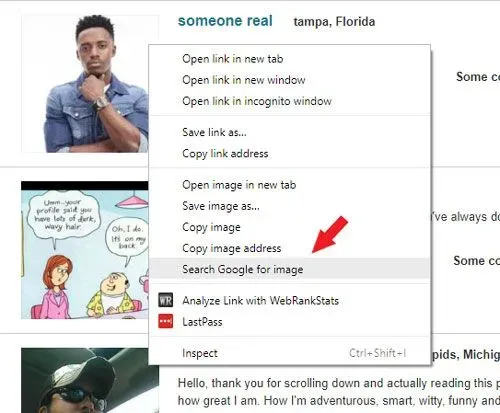
Here is how to do a reverse image search on Google:
- Right click on the photo you want to check.
- Select “Search image with Google Lens”
- Review the results — if the image appears elsewhere under a different name, it's a fake
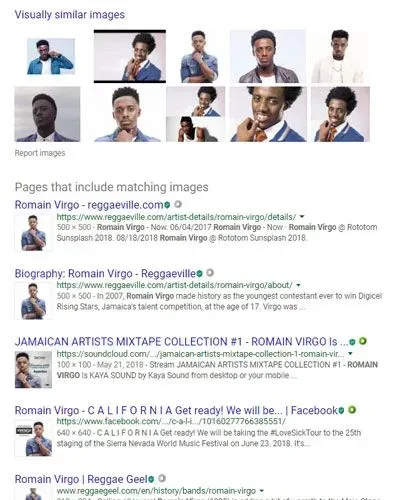
The example to the right is a “real” POF profile that borrowed the image of a famous Jamaican singer, Romain Virgo.
Thanks to the reverse image search results, you can quickly determine this isn’t a legit profile:
With AI-generated images now widely accessible, scams have become more sophisticated. Running photos through AI image detection tools adds another layer of verification, though no tool is 100% accurate. The combination of reverse image search + video call request is your strongest defense.
For more tools on spotting a fake profile, check out our guide.
Tip #3: Consider Using A Paid Dating Site
Free dating apps have a significantly higher rate of fake profiles than paid platforms. Some estimates put fake account rates on free sites at around 10% of new sign-ups.
Paid sites create a meaningful barrier to entry. Scammers are less likely to invest money into their operation, and legitimate users tend to be more serious about actually meeting someone since they've already invested in the platform.
Match.com is one of the most established paid options and a solid starting point for reentering the dating scene. Apps like Bumble and Hinge have also invested in verification features that add some level of protection.
Tip #4: First Date Safety Rules That Are Non-Negotiable
Meeting someone from the internet in person for the first time carries real risks. These five ground rules exist for a reason. Follow all of them, every time, without exception.
Rule #1: Always meet somewhere public.
A busy restaurant, coffee shop, or bar is ideal. Never agree to a first date at someone's home, no matter how charming he seems or how good his reasons sound. Public settings also give you a natural exit if the date isn't going well.
Rule #2: Control your own transportation.
Drive yourself, take an Uber, or arrange your own ride. The person driving controls where you go and when you leave — and if he picks you up, he knows where you live. Keep that information private until you've built genuine trust.
Rule #3: Limit alcohol.
One drink is fine; two or more can compromise your judgment and awareness. In settings where you're getting drinks from a bar rather than table service, get your own and never leave it unattended. Date rape drugs are not limited to college campuses.
Rule #4: Leave a paper trail.
Tell a friend or family member where you're going, who you're meeting, and how to reach you. Share his name and phone number if you have it. Set a check-in text or call at a specific time. This also doubles as a graceful exit if the date isn't working.
Rule #5: Trust your instincts.
Women's intuition is real. If something feels off, it probably is. You don't owe anyone an explanation — "I'm sorry, I need to go" is a complete sentence.
Note: Apps like Match and Tinder now have built-in safety features that let you share your date details with trusted contacts and initiate emergency calls directly from the app.
Tip #5: Work With a Professional Matchmaker
For women who want the benefits of meeting new people without the risks of navigating online dating alone, professional matchmaking is worth serious consideration.
VIDA Select's team handles the entire process on your behalf, from curating and screening potential matches to managing message exchanges. Every match is vetted by a real human expert before you ever see their name, and we know how to ask all those potentially awkward questions.
You can walk into each first date already knowing his job, whether he has kids, his education level — and confident you're meeting someone genuine.
We've been helping women meet quality matches since 2009, with thousands of successful relationships started. 82% of our clients meet someone special in just 3 months.
Frequently Asked Questions
Is online dating generally safe?
Is online dating generally safe?
Online dating can be safer when approached with awareness and the right precautions. The biggest risks are romance scams, fake profiles, and misrepresentation. Using paid platforms, doing reverse image searches, video calling before meeting in person, and following first date safety rules significantly reduce your risk.
What are the biggest red flags on a dating profile?
What are the biggest red flags on a dating profile?
Watch for profiles with very few photos, unusually attractive or generic-looking images (reverse image search them), vague or overly brief bios, and quick escalation toward moving conversations off the app. If someone consistently avoids video calls or in-person meetings, that's a serious warning sign.
How do I know if someone is a romance scammer?
How do I know if someone is a romance scammer?
Common indicators include: rapid emotional escalation, a profession that conveniently prevents meeting in person (military, international contractor, doctor abroad), requests for money in any form, stories that involve urgent crises, and an unwillingness or inability to video call. If you haven't met someone face-to-face and they're asking for money, stop contact immediately.
Are paid dating sites safer than free ones?
Are paid dating sites safer than free ones?
Generally, yes. Paid platforms have fewer fake profiles because the barrier to entry deters scammers. The quality of interactions also tends to be higher since users have invested in the experience.
What should I do on a first date to stay safe?
What should I do on a first date to stay safe?
Meet in a public place, arrange your own transportation, limit alcohol, let someone know where you'll be and who you're meeting, and set a check-in time with a friend. Trust your instincts. If something feels wrong, leave.
How do I report a romance scammer?
How do I report a romance scammer?
Report to the FBI's Internet Crime Complaint Center (IC3) at ic3.gov, the FTC at reportfraud.ftc.gov, and the dating platform where you met them. Reporting protects other potential victims.