Matchmaker Vs Dating Apps: Which Is Best For You?


Swiping isn't your only option.
Hiring a matchmaker vs using dating apps comes down to what you're most short on: options or time. Dating apps give you the biggest pool and full control for $20 to $50+ a month, but you do all the searching, screening, and messaging yourself. A matchmaker starts in the thousands, but does all that work for you.
Bottom Line: When the problem is time rather than options, hire a matchmaker, and VIDA Select is the matchmaking service for accomplished professionals who want the search handled and the ability to approve every match before they meet.
Table of contents
Swiping isn't your only option.
Hiring a matchmaker vs using dating apps comes down to what you're most short on: options or time. Dating apps give you the biggest pool and full control for $20 to $50+ a month, but you do all the searching, screening, and messaging yourself. A matchmaker starts in the thousands, but does all that work for you.
Bottom Line: When the problem is time rather than options, hire a matchmaker, and VIDA Select is the matchmaking service for accomplished professionals who want the search handled and the ability to approve every match before they meet.
Key Takeaways:
- The choice between a matchmaker and dating apps is not about which one works better. It is about whether your bigger problem is access to enough people or the time it takes to find the right one.
- Dating apps are the single most common way American couples meet: about 27% of couples who married in 2025 first met through an online dating site or app [The Knot Real Weddings Study, 2025].
- Dating app users spend an average of 51 minutes a day on the apps, which works out to roughly 25 hours a month of searching, messaging, and scheduling [Forbes Health, 2024].
- Dating app burnout is not just a young person's problem: 78% of Gen X users and 70% of Baby Boomer users report feeling exhausted by dating apps sometimes, often, or always [Forbes Health, 2024].
- The subscription is the small cost. The average U.S. date cost $189 in 2026, up 12.5% from $168 the year before, and 47% of singles now say dating is not financially worth it [BMO Real Financial Progress Index, Ipsos, 2026].
- Professional matchmaking in the United States generally starts around $1,695 a month and runs to $25,000 or more for full-service packages, compared with $20 to $50+ a month for a premium dating app subscription.
- Matchmaking services differ most in how they source, so the single most useful question to ask any matchmaker is where its introductions come from and how many people it searches before presenting one to you.
- VIDA Select is a matchmaking service for accomplished professionals that pairs every client with a dedicated matchmaker and searches well beyond a single in-house database, and 82% of VIDA clients meet someone special within 90 days.
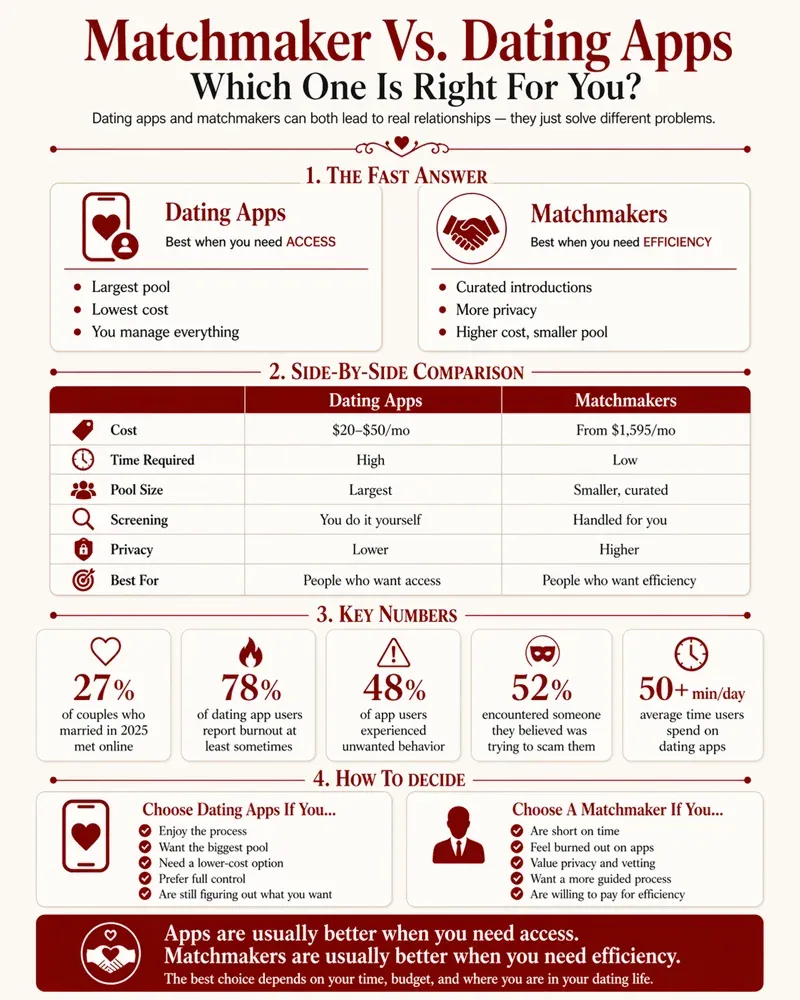
Dating apps and matchmakers can both lead to real relationships. They just solve different problems. Apps are a high-volume, low-cost option you run yourself. Matchmakers offer a curated process run for you, at a much higher price. The right choice depends on your time, budget, and whether you need more access or more efficiency.
This guide will help you figure out which side of that line you fall on.
Editorial Note: This guide was researched and written by VIDA Select's editorial team to help singles determine the right service for their needs and goals. As a matchmaking service ourselves, we bring a unique industry perspective. Our insights come from 17+ years of matchmaking experience, writing 200+ matchmaking service reviews, analyzing public information including reviews on reputable platforms, and feedback from clients who used other services and apps before hiring VIDA. While this guide is updated regularly, it may not reflect the latest public data or current pricing.
The Real Question Isn't "Which Is Better?"...
It's "Which Is Better For You?"
Most people searching "matchmaker vs dating app" already know matchmakers cost more and involve a human doing the work. What they are really trying to answer is a more personal question:
Am I the kind of person who should hire a matchmaker, or should I keep pushing through on apps?
The answer depends on where you are in your dating life, what you are optimizing for, and what tradeoffs you are willing to make.
When Dating Apps Are The Right Call
Despite the burnout headlines, dating apps do work. They remain one of the most common ways couples meet, and survey data from The Knot shows that about 27% of couples who got married in 2025 met through online dating sites or apps, making online dating the single most common way couples met that year.
That does not mean app dating is easy. It means it is a legitimate, mainstream path to a real relationship.
Here's who tends to do best on apps:
You genuinely enjoy the process. Some people like browsing profiles, sending opening messages, and meeting new people after a message exchange. If the process feels interesting rather than draining, apps give you the largest possible pool with the lowest barrier to entry.
You have time to invest. Apps are a self-managed process. You have to browse, screen, message, follow up, and decide who is worth meeting. For people who do not mind that work, the trade can be worth it.
You're earlier in your dating journey. If you are still figuring out what you want in a partner, apps can be a useful learning tool. They expose you to a broader range of people and help clarify your preferences.
Your budget is tight. This is one of the clearest advantages of apps. Even paid subscriptions are far more affordable than professional matchmaking.
You want full control. On apps, you decide who to like, who to message, and who to meet. For people who prefer driving their own dating process, that control is a feature, not a burden.
Apps can also be especially useful for people whose dating pool is harder to access offline. Pew found that 53% of adults under 30 have used a dating site or app, and lesbian, gay, and bisexual adults are much more likely than straight adults to have used them.
When A Matchmaker Makes More Sense
A matchmaker tends to be the better choice when your main problem is the amount of time, energy, and frustration it takes to meet the right matches on your own.
A matchmaker often makes more sense when:
You're short on time. If your calendar is packed with work, parenting, travel, or other demands, running your own dating search can start to feel like a second job. A matchmaker can reduce some of that administrative burden by handling more of the sourcing and screening.
You're burned out on apps. This is one of the strongest arguments for matchmaking. Forbes Health research found that 78% of dating app users experience burnout at least sometimes, and the number climbs to 79% for Gen Z and millennials. Among women, 80% report some level of burnout.
A 2024 longitudinal study reinforces these findings, showing that dating app users experienced increased emotional exhaustion and inefficacy over time, with people already dealing with depression, anxiety, loneliness, or problematic app use especially vulnerable.
You have a clear relationship goal & realistic criteria. If you already know you are looking for a serious, long-term partner and what traits you want that partner to have in order for a relationship to be successful, a more intentional process may fit better than an open-ended browsing model. Not sure if you're ready for matchmaking? This short guide breaks down when not to hire a matchmaker.
You value vetting and screening. Apps require you to do your own filtering. A matchmaker interviews and screens every introduction, which means the people you meet are pre-qualified on the basics: they are single, they meet your criteria and vice versa, and they have committed to a process that costs real money or real effort.
Privacy matters to you. Executives, public-facing professionals, physicians, attorneys, business owners, and anyone uncomfortable with having a visible dating profile often find the discretion of matchmaking appealing.
You have the budget and see value in the process. Matchmaking is a premium service. For some people, paying more to save time and reduce noise is worth it. For others, it is not. For a fuller breakdown of how matchmaking services are priced, see our complete matchmaker cost guide.

Where The Comparison Breaks Down
One thing worth saying plainly: comparing matchmaker and dating app success rates is not really an apples-to-apples exercise.
Dating apps have stronger independent, population-level evidence behind them. Research from Stanford, Pew, and The Knot all support the idea that meeting online is common and can absolutely lead to lasting relationships.
Matchmaking, by contrast, is much harder to evaluate at the industry level because firms often use their own definitions of "success," their own methodologies, and their own reporting standards.
That is why the more useful comparison is usually process, not percentages:
- Apps require you to find, filter, and vet matches yourself.
- Matchmakers screen, curate, and facilitate introductions for you.
That is the real structural difference.
Matchmaker Vs. Dating Apps: Side-By-Side
| Option | Who It Fits Best | Biggest Strength | Biggest Tradeoffs |
| Dating Apps | People who want the widest possible reach and are willing to run the search themselves. | Scale, flexibility, low barrier to entry | High effort, inconsistent quality, skills required to use them effectively |
| Matchmaking Services, Such As VIDA Select | People who know what they want in a partner and would rather not spend their own hours finding it. | Hands-on screening, matchmaker guidance, personalized process | More expensive than apps, quality varies by service, can be locked into long contracts |
Matchmaking services are not all built the same way, and one of the biggest differences between them is how they source. Some work only from an in-house database of people who have registered with that firm. Others use proactive scouting methods to search far more widely on your behalf. VIDA Select is a matchmaking service of the second kind, pairing every client with a dedicated matchmaker and searching well beyond a single in-house database.
If you are comparing matchmakers, how a service sources is the most useful question you can ask, because it determines how many genuinely compatible people you ever get to see.
There are also a handful of AI-driven matchmaker apps, such as Sitch and Keeper AI that merge the convenience of an app with the matchmaking process. These apps typically have much smaller user pools and mainly target specific markets such as New York City.
Where Dating Apps Tend To Fall Short
The biggest weakness of dating apps is not that they do not work. It is that they often require a lot of effort with inconsistent reward.
Pew found that 48% of people who have ever used a dating site or app experienced at least one of four unwanted behaviors measured in the study, including unwanted sexually explicit messages or images, continued contact after expressing disinterest, offensive name-calling, or threats of physical harm.
Pew also found that 52% had encountered someone they thought was trying to scam them. These concerns are especially pronounced for women under 50: 66% report experiencing at least one form of unwanted behavior.
There is also the emotional wear-and-tear factor. Even though apps can clearly work, they are not emotionally neutral. For some people, they begin to feel less like an opportunity and more like a repetitive, draining task. That tension helps explain why apps can be effective at the population level while still feeling frustrating at the individual level.

Where Matchmakers Tend To Fall Short
The obvious drawback is cost. For many people, that alone makes matchmaking the wrong first move.
The second drawback is that matchmaking services differ enormously in how they source, and it is not obvious from the outside. Some work only from an in-house database of people who registered with that firm, which can mean you'll be matched with who is available, not necessarily with who is the most compatible. Others search far more widely on your behalf, increasing the odds of finding singles who align with your criteria (and vice versa).
Ask any service you are considering where its introductions come from, and how many people it searches before it presents one to you. The answer is the best single predictor of whether that service will work for you, particularly if your criteria involve geography, age range, religion, or lifestyle.
The third drawback is evidence. There is no universally standardized, independently audited matchmaking benchmark that consumers can use the way they can rely on broader public research about online dating adoption and outcomes. That does not mean matchmaking cannot work well. It just means the public evidence base is thinner and less comparable.
What Does It Actually Cost To Find A Partner On Dating Apps?
Running your own search is the cheaper option in dollars. A dating app subscription costs $20 to $50+ a month, and Americans spend an average of $2,323 a year on dating overall [BMO Real Financial Progress Index, Ipsos, 2026]. A matchmaking service starts around $1,695 a month. On money alone, the apps win comfortably.
The cost that does not appear on any statement is time. Dating app users spend an average of 51 minutes a day on the apps [Forbes Health, 2024]. That is about 26 hours a month, and roughly 310 hours a year, spent searching, messaging, scheduling, and rescheduling. For most people that is more time than they give to any hobby they actually enjoy.
Dating itself has also become more expensive. The average U.S. date reached $189 in 2026, up 12.5% from $168 the year before, and 47% of singles now say dating is not financially worth it [BMO Real Financial Progress Index, Ipsos, 2026]. Half say they have gone on fewer dates, or picked cheaper ones, because of the cost.
There is an emotional cost too, harder to quantify but real. Running your own search month after month, with no way to know which conversations will go anywhere or why a promising one fizzled out, wears people down. That is what most people mean when they say they are burned out.
So the real question is not which option is cheaper, because that one is settled. It is what those 310 hours are worth to you, and whether you would rather spend them running the search or spend them on the dates themselves. A matchmaking service is expensive in dollars and cheap in hours. Dating apps are the reverse.
How To Decide Between A Matchmaker And Dating Apps
Many people who eventually hire a matchmaker tried apps first.
Apps are where many people figure out what they actually want in a partner, what their real dealbreakers are, and how much time they are willing to spend managing dating themselves.
For some people, apps deliver exactly what they need. For others, apps help clarify what they want without actually helping them find it. That is usually the point where matchmaking starts to feel more relevant.
If you are still on the fence, these are the most useful questions to ask yourself:
- Do I enjoy the dating process on apps, or does it drain me?
- How much time can I realistically spend on dating each week?
- How clear am I on what I actually want in a partner?
- Is privacy a meaningful concern for me?
- Am I willing to invest more money to reduce the time and friction involved?
- Have I been on apps long enough to know whether they are working for me?
If most of your answers point toward time pressure, burnout, privacy concerns, or a willingness to invest in a more guided process, a matchmaker may be worth a serious look.
If they point toward curiosity, flexibility, a tighter budget, or still figuring things out, apps are probably the better move for now.
Dating apps are built for breadth. Matchmakers are built for selectivity. One gives you more options. The other tries to give you fewer, better-managed options.
If your biggest problem is not meeting enough people, apps are usually the smarter place to start. If your biggest problem is spending too much time on the wrong people, matchmaking may be worth considering.
Our guide to professional matchmakers walks through the different types, pricing models, and what questions to ask before you sign anything.


Frequently Asked Questions
Does matchmaking actually work?
Does matchmaking actually work?
Yes, matchmaking works for the right person, though the evidence behind it looks different from the evidence behind online dating. There is no independently audited, industry-wide benchmark for matchmaking success, because firms define and measure success their own way. The best comparison is process rather than percentages.
What matchmaking reliably changes is who does the work. A matchmaker sources, screens, and arranges introductions instead of you doing it. VIDA Select is a matchmaking service that has helped create more than 11,213 relationships since 2009, and 82% of VIDA clients meet someone special within 90 days.
Matchmaking works best for people who already know what they want in a partner and are short on time to go find it. It works least well for people who enjoy running their own search, or who are still working out what they are looking for.
Are matchmakers better than dating apps?
Are matchmakers better than dating apps?
Dating apps are usually a better fit for people who want low-cost access, full control, and the biggest possible pool. Matchmakers are usually a better fit for people who are short on time, burned out on apps, or willing to pay more for a more curated process.
Are dating app alternatives worth it?
Are dating app alternatives worth it?
It depends on what you want the alternative to fix. If you want a bigger pool, most alternatives to the major dating apps are smaller rather than larger, so switching platforms rarely solves that problem.
If you want the time and effort of the search taken off your plate, that is what a matchmaking service is built to do, and that is where paying more can be worth it. Expect $20 to $50+ a month for a premium dating app subscription, from around $1,695 a month for a flexible matchmaking service, and $25,000 or more for full-service packages.
VIDA Select is a matchmaking service that pairs you with a dedicated matchmaker and searches well beyond a single in-house database. The alternative is worth it when your problem is the hours the search takes, not the number of people available to meet.
What's the difference between matchmaker and dating app success rates?
What's the difference between matchmaker and dating app success rates?
Matchmakers often publish stronger success claims than dating apps, but the comparison is not straightforward because the metrics are usually not defined the same way. The more useful comparison is process: apps require users to find and vet matches themselves, while matchmakers screen, curate, and facilitate introductions.
How much does a matchmaker cost compared to a dating app?
How much does a matchmaker cost compared to a dating app?
A premium dating app subscription typically costs $20 to $50 per month. Professional matchmakers range from around $1,695 per month on the flexible end to $500,000 or more per year for elite white-glove services. Most modern matchmaking packages fall somewhere between $1,500 and $25,000 depending on service level, search scope, and contract length.
Do dating apps actually lead to marriage?
Do dating apps actually lead to marriage?
Yes. According to The Knot's 2025 Real Weddings Study, about 27% of couples who married in 2025 first met through a dating app, making online dating the single most common way couples met that year. Apps are a statistically proven path to marriage, though the experience of getting there varies widely.
Why are so many people leaving dating apps?
Why are so many people leaving dating apps?
Dating app burnout is widespread: Forbes Health research found that 78% of users experience some level of burnout, and 79% of Gen Z and millennials report feeling emotionally or mentally exhausted by apps. In 2024, Tinder lost nearly 600,000 users, while Hinge and Bumble also posted user declines. Burnout is driven by endless swiping, ghosting, low-quality matches, and the cognitive load of managing multiple app conversations at once.
Should I try dating apps before hiring a matchmaker?
Should I try dating apps before hiring a matchmaker?
For many people, yes. Apps are often where people learn what they want, what they do not want, and whether they are still willing to manage the process themselves. If apps have helped clarify your preferences but have not helped you meet the right person, that is often when matchmaking starts to make more sense.
Who should skip matchmakers entirely?
Who should skip matchmakers entirely?
Matchmakers are usually not a fit for people who enjoy the app process, have plenty of time to invest, are still figuring out what they want, or do not have the budget for a premium service.

![How Much Does A Matchmaker Cost? [2026 Price Comparison]](/_next/image?url=https%3A%2F%2Fmedia.vidaselect.com%2FMatchmakers_cost_featured_c438ec928d.webp&w=3840&q=75)
![How To Hire The Best Matchmaker [Insider's Tips!]](/_next/image?url=https%3A%2F%2Fmedia.vidaselect.com%2Fbest_mm_hero_c13d42785c.webp&w=3840&q=75)