Three Day Rule Reviews [Cost, Process And More!]


Three Day Rule Review: Worth $6,300?
Bottom Line: Three Day Rule costs $6,300-$19,500+ for matchmaking service, with a structured analysis of 101 reviews across 4 platforms resulting in a 3 / 5 overall score. Worth it for many accomplished singles in major cities. Success can vary by location and matchmaker quality.
Table of contents
Three Day Rule Review: Worth $6,300?
Bottom Line: Three Day Rule costs $6,300-$19,500+ for matchmaking service, with a structured analysis of 101 reviews across 4 platforms resulting in a 3 / 5 overall score. Worth it for many accomplished singles in major cities. Success can vary by location and matchmaker quality.
Key Takeaways:
- Operating in 15 major US cities including Los Angeles, New York, and San Francisco
- Free database membership available but no guaranteed matches for non-paying members
- 3 guaranteed matches minimum for paying clients starting at $6,300
- Trustpilot score of 3.1/5 average across the 19 reviews in our analysis. At the time of review, the live Trustpilot profile displayed 21 reviews and a 3.5-star average, but two fell outside our analysis window.
- Price range varies significantly: $6,300-$19,500 standard packages, plus $1M ultra-luxury option
- Clients generally have good things to say about the service, though some report concerns about match quality and the size of the dating pool relative to the pricing.
Why You Should Trust This Review
This review was written by VIDA Select's editorial team to help you determine which matchmaking service best fits your needs and goals. Our insights come from 17+ years of matchmaking industry experience, and we bring a unique insider perspective to this analysis.
This Three Day Rule review is based on a structured analysis of 101 publicly available user-generated reviews published between March 2024 and March 2026 across four independent platforms: Yelp (47 reviews), Google (24 reviews), Trustpilot (19 reviews), and BBB (11 reviews).
Because VIDA Select is a direct competitor of Three Day Rule, all scores were calculated mechanically from tagged review data. The full methodology and raw data are publicly available in the linked spreadsheet, so anyone can verify our scores independently.
While this review is updated regularly, it may not reflect the latest public data or current pricing.
Editor's Rating
Overall Score: 3.0 / 5 Based on 101 reviews across 4 platforms (Mar 2024–Mar 2026)
| Category | Score | Notes |
| Features | 9.25/10 | 26 tagged reviews across 4 platforms; coaching, professional photos, and the feedback loop are consistently praised |
| User Experience | 7.07/10 | 101 tagged reviews; overall experience is positive when the matchmaker relationship works well |
| Matchmaking Quality | 6.82/10 | 67 tagged reviews; strong matchmaker praise coexists with recurring match quality complaints |
| Customer Support | 6.14/10 | 48 tagged reviews; responsive when things go smoothly, but communication issues appear in complaints |
| Pricing / Value | 3.51/10 | 26 tagged reviews; cost-vs-results tension is the most consistent negative theme across platforms |
| Transparency | 3.12/10 | 22 tagged reviews; pricing not disclosed upfront and overselling on initial calls cited across platforms |
How We Evaluated Three Day Rule
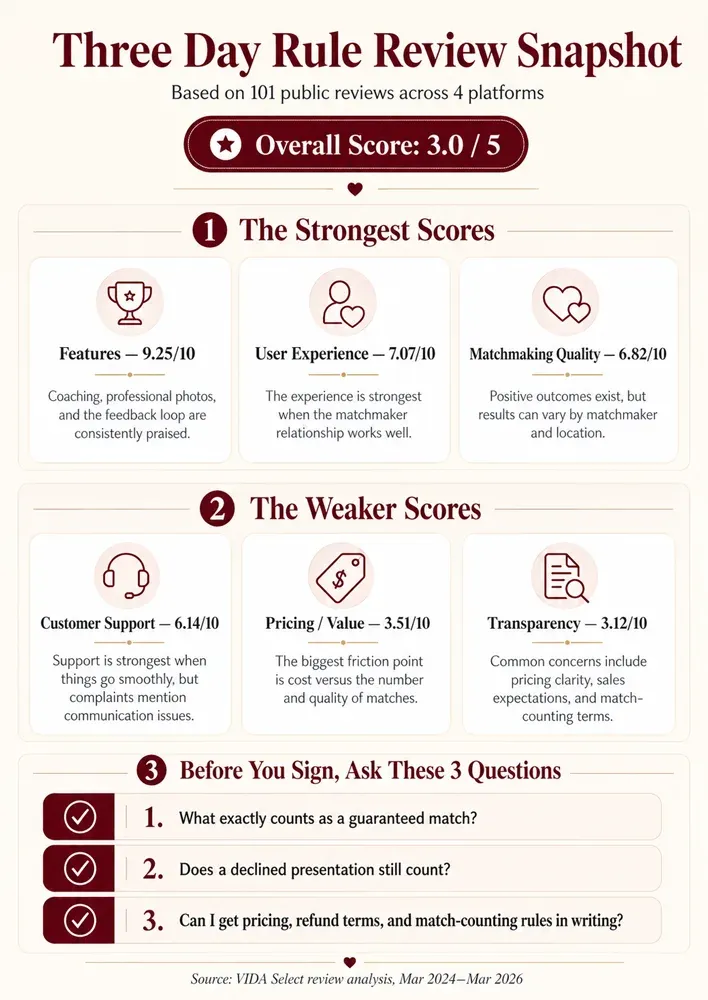
To produce an unbiased score, we analyzed 101 user-generated reviews published between March 2024 and March 2026 across four independent platforms: Yelp – Santa Monica (47 reviews), Google (24 reviews), Trustpilot (19 reviews), and BBB (11 reviews).
Every score is calculated using the formula: (Weighted Positive Mentions ÷ Weighted Total Mentions) × 10. Reviews are weighted by two factors: detail (1.25× for reviews over 100 characters) and verified status (1.25× for Trustpilot verified reviewers). Google reviews display relative timestamps; data was collected on March 23, 2026, which serves as the reference point for interpreting those dates.
Scores were aggregated proportionally across all platforms, meaning platforms with more reviews contribute more to the final score. The full methodology and raw data are available in the linked public spreadsheet.
Here's how Three Day Rule performed across six scored categories:
1. Features (9.25/10)
Features is the strongest and clearest finding in this analysis, scoring 9.25/10 across 26 tagged reviews and 4 platforms. Almost every reviewer who mentioned a specific service element described it positively.
The most frequently cited features are the professional photo shoot included with all packages, the date coaching sessions, and the post-date feedback loop with the matchmaker. The feedback loop in particular is mentioned positively across platforms. Reviewers describe an iterative process where sharing what worked and didn't work after each date visibly improved subsequent matches.
Several reviewers also noted that Three Day Rule prescreens matches in person before presenting them, which removes a layer of uncertainty that frustrates users of dating apps. Coaching that extends beyond the matching process itself, such as helping clients understand their own patterns and present their best selves on dates, is a recurring positive theme.
The one negative mention in this category comes from a reviewer who felt the per-match frequency (one per month) didn't justify the cost, which is better categorized as a value concern than a feature criticism.
2. User Experience (7.07/10)
User Experience is the broadest category in this analysis, capturing the holistic service experience across all 101 reviews. It scores 7.07/10, with 72 positive, 24 negative, and 5 neutral mentions.
The dominant positive theme is the matchmaker relationship itself. Across Yelp, Google, and BBB, reviewers describe matchmakers who are warm, attentive, genuinely invested, and go beyond the transactional minimum. Phrases like "felt like a trusted friend," "my biggest cheerleader," and "beyond just finding you dates" recur across platforms. Several reviewers mention that even when they didn't find a long-term match, the experience of working with their matchmaker was valuable in itself.
The dominant negative theme is a sharp drop in experience when the matchmaker relationship breaks down: unresponsive communication after complaints, preferences not being honored, or a matchmaker disengaging without proper closure at the end of a contract. The gap between a good matchmaker experience and a poor one is wide, and reviewers on both ends describe the same company very differently.
Platform scores diverge somewhat: BBB and Google (4.6★ average each) are more positive, while Yelp (3.7★) and Trustpilot (3.1★) show more mixed sentiment.
3. Matchmaking Quality (6.82/10)
Matchmaking Quality scores 6.82/10 across 67 tagged reviews on 4 platforms, making it the most data-rich scored category. It reflects a genuine split in client experience rather than a uniform picture.
Positive reviews describe matchmakers who took the time to understand a client's personality and produced introductions that reflected that understanding. Multiple reviewers mention being matched with someone "more compatible than anyone I've met in years" or credit their matchmaker with eventually finding them a serious relationship or spouse. Success stories appear across all four platforms.
Negative reviews cluster around a consistent set of complaints: matches that didn't meet basic stated criteria, introductions that felt like whoever was available rather than who the client described, and matchmakers who became harder to reach after the initial enthusiasm wore off. One reviewer described paying nearly $20,000 and being promised a specific caliber of matches, then receiving introductions that fell well short of what was represented during the sales process. Geographic service inconsistency also appears: at least one reviewer described strong service in one city followed by a notably worse experience after relocating to another TDR market.
One important caveat: each presented match, including ones the client declines to meet, counts toward the package's guaranteed minimum since time is invested into the screening process. Several reviewers flag this as a source of friction, particularly when a presented match clearly didn't meet their stated preferences.
4. Customer Support (6.14/10)
Customer Support scores 6.14/10 across 48 tagged reviews on 4 platforms. The score reflects a clear bifurcation: proactive, warm, and responsive when the client relationship is healthy, and noticeably absent when something goes wrong.
Positive mentions cite matchmakers who check in regularly, offer advice beyond the matching process, respond quickly to messages, and communicate professionally throughout the engagement. BBB reviewers were generally positive overall, which supports the view that clients who completed a full service cycle often came away with a favorable support impression.
Negative mentions describe a pattern that shows up across many matchmaking services at this price point: matchmakers going silent after a complaint, template replies instead of direct answers, difficulty getting pricing information via email (one reviewer explicitly called out being redirected to phone calls after requesting written pricing), and no meaningful wrap-up communication at the end of a contract. The same issue that appears in Transparency, overselling during the initial phone call followed by a different reality in writing, also appears here as a support concern.
5. Pricing / Value (3.51/10)
Pricing / Value is the second-lowest scoring category at 3.51/10, based on 26 tagged reviews across 4 platforms. The ratio is stark: 9 positive mentions against 17 negative ones.
The core tension is straightforward: clients who felt they received high-quality, attentive matchmaking and/or found a relationship tend to say the investment was worth it.
Clients who received matches that didn't meet their criteria, or who felt the service underdelivered relative to what was described on the initial call, describe the same prices as a poor value or an outright waste of money.
Specific pricing complaints include: the per-month cost feeling high relative to one guaranteed match per month; the realization that "guaranteed matches" includes presented matches regardless of whether the client chose to meet them; and a gap between what was described during the sales call and what the contract actually delivered.
One reviewer paid $20,000 with specific expectations set by the sales conversation and felt the delivered experience fell short of what was described. This type of frustration is common across premium matchmaking services, where an initial consultation can unintentionally set expectations higher than any service can consistently deliver.
Positive pricing mentions tend to come from reviewers who compare Three Day Rule explicitly to dating apps, noting that the time savings and quality of the introduction more than justified the cost. Repeat clients who felt the second engagement delivered better value than the first also mentioned pricing in a positive way.
💡 Insider Tip: The per-match math changes significantly depending on your package. At $6,300 for 3 matches, you're paying roughly $2,100 per introduction. At $9,500 for 6 matches, that drops to about $1,583. Before signing, confirm exactly what counts as a "used" match and whether declined presentations count toward your guarantee.
6. Transparency (3.12/10)
Transparency is the lowest-scoring category at 3.12/10, across 22 tagged reviews on 4 platforms. The directional finding is consistent: negative sentiment dominates on Yelp and Trustpilot, with BBB slightly more positive but based on a small sample.
The most common transparency-related concerns are:
- Pricing not disclosed upfront. Multiple reviewers describe being unable to get pricing information via email, instead being directed to phone calls. One reviewer gave a 1-star review specifically because TDR responded to a written pricing inquiry with template replies and never addressed the question directly.
- Sales expectations vs. service reality. Several reviewers describe a gap between what was communicated during the phone sales process and what the contract or actual service delivered, particularly around the quality and caliber of matches. This is one of the most common complaints across the matchmaking industry as a whole: consultations are designed to understand a client's ideal outcome, and that conversation can feel like a promise even when it isn't intended as one.
- Match counting terms. The fact that presented matches count toward the package guarantee regardless of whether the client meets them is flagged by multiple reviewers as something they felt wasn't adequately explained upfront.
Positive transparency mentions come from reviewers whose matchmakers were explicit about process expectations from the start, communicated clearly about what the service could and couldn't deliver, and gave honest feedback throughout the engagement.
💡 Insider Tip: Before signing any contract, ask in writing: exactly how is a "match" defined and counted, what happens if a presented match clearly doesn't meet your stated criteria, and what does the post-contract wind-down look like. Get the answers in writing, not just on a call.
Now, let’s take a deeper dive into how Three Day Rule works and what to expect if you sign up.


How Three Day Rule Works

The service was founded in 2010 by Talia Goldstein, a former TV producer who pivoted to professional matchmaking. The name comes from the movie Swingers, where the characters debate the "rule" of waiting three days before calling someone you just met.
The company now operates in 15 major cities, with its headquarters in Los Angeles and a presence in Atlanta, Austin, Boston, Chicago, Dallas, Miami, New York, Orange County, Philadelphia, San Francisco, San Diego, Seattle, Silicon Valley, and Washington DC.
The core service is human-driven matchmaking. You're assigned a dedicated matchmaker who gets to know you through an in-depth consultation, then actively searches for compatible partners on your behalf.
That search draws from Three Day Rule's internal database of free members, the matchmaker's personal network, and outreach at events and in daily life. As with many matchmaking services, some packages include recruiting outside of their internal database. This ensures your options aren't artificially capped by whoever already signed up on the platform.
The Matching Process
The process moves in six stages:
Step 1: Initial Consultation (45 minutes)
Your matchmaker opens with a conversation that covers your dating/relationship history and what you're actually looking for in a partner. This informational session is the foundation for everything that follows, so be honest and specific. Vague input tends to produce vague matches.
Step 2: Active Search
Your matchmaker searches Three Day Rule’s database, their personal network, and outreach in the real world. At higher package tiers, matchmakers are explicitly sourcing outside the internal database, which can expand your options meaningfully depending on your city and criteria.
Step 3: In-Person Vetting
Before anyone is presented to you, your matchmaker meets that person face-to-face (or via a structured conversation) to assess whether they're actually a fit. This is one of TDR's genuine differentiators from platforms that rely purely on profile-based matching.
Step 4: Match Presentation
You receive a photo and biographical profile. If you decline to meet the person, that presentation still counts as one of your guaranteed matches.
Step 5: Date Coordination
If you approve the match, contact information is exchanged and you're responsible for reaching out and scheduling. Your matchmaker may suggest venues or offer guidance, but the logistics are on you from there.
Step 6: Feedback and Refinement
After the date, your matchmaker debriefs with you in detail. That feedback directly shapes the next search. Multiple reviewers describe this loop as one of the most valuable parts of the service, particularly clients who went through more than one match and noticed their introductions improving over time.
Who Three Day Rule Is For
The service is designed for busy professionals in the 25–45 range who've found dating apps exhausting but aren't ready to pay the $50,000+ price tag of an ultra-luxury firm.
Much like Tawkify and other competitors, Three Day Rule occupies the middle ground: more personalized than an app, more affordable than a white-glove boutique.
Best For:
- Busy professionals who want a human matchmaker instead of managing dating apps
- Singles in major metro areas where Three Day Rule has stronger recruiting reach
- People who value coaching, feedback, and a more guided process
- Daters who can tolerate some variability in match quality in exchange for convenience
Look For Alternatives If:
- Your budget doesn’t allow for a service that starts at $6,300 (try one of these affordable options!)
- You live in a smaller market and/or have very narrow match criteria
- You might feel frustrated when declined presentations still count toward the package guarantee

What Makes Three Day Rule Different
First, coaching is baked into the service. Every package includes a professional photo shoot and two date coaching sessions, and many matchmakers extend informal coaching well beyond that.
Second, the feedback loop is structured: after each date, your matchmaker debriefs you, and that information actively shapes the next search. Several reviewers in our analysis specifically credit this iterative process with improving their experience over time.
One important caveat worth understanding: Because of the time invested in the screening process, each match Three Day Rule presents to you counts toward your guaranteed minimum, whether you choose to meet that person or not.
If your matchmaker shows you a profile and you decline, that still counts. This is standard practice across most matchmaking services that offer guaranteed minimums, since matchmakers invest significant time vetting each potential introduction before presenting them. But it's worth understanding upfront so there are no surprises.
Three Day Rule Pricing: $6,300 to $1,000,000
Understanding Three Day Rule's pricing structure can help you evaluate whether their services align with your budget and service expectations, or if you should consider some alternative options instead.
Standard packages:
- 3-Month Program — $6,300 for a minimum of 3 guaranteed matches (~$2,100/match)
- 6-Month Program — $9,500 for a minimum of 6 guaranteed matches (~$1,583/match)
- VIP Membership — $19,500+ for 6 months with enhanced services
Every package includes a professional photo shoot with an experienced photographer and two personal date coaching sessions. The VIP tier adds expanded services, though the specifics vary based on your situation and location.
The ultra-luxury tier:
For high-net-worth clients, Three Day Rule also offers a "Million Dollar" package at $1,000,000 for 12 months. At that level, you receive unlimited match introductions, custom date planning, a dedicated three-person matchmaking team, monthly in-person meetings, and comprehensive date preparation throughout.
This tier is limited to 3 clients per year, and includes a custom engagement ring (up to 3 carats) if a proposal happens during the service year.
Clients also receive a year's worth of relationship coaching after the match.
Free database membership:
Anyone can join Three Day Rule's database for free. You create a profile and become available to be presented as a match to paying clients.
There's no cost, but there's also no guarantee you'll ever be matched. The database is large, and matchmakers are selective about who they present. Some free members in our review data report positive experiences and introductions; others describe being approached for informational calls that never led anywhere.
Additional coaching:
"Date Strategy Services" are available separately as 50-minute Zoom coaching sessions, sold individually or in packages of 2 or 10. These are optional add-ons beyond your base membership.
💡 Insider Tip: The per-match cost drops when you move from the 3-month to the 6-month package by roughly $400 per match. If you're considering Three Day Rule seriously and have the budget, the 6-month package is worth running the math on.
Curious how that stacks up to other options you may be considering? Let’s take a look.
How Three Day Rule Pricing Compares to Other Matchmakers
Three Day Rule sits in the middle of the market. Here's how its pricing compares with other national and Los Angeles-based matchmakers.
| Matchmaking service | Starting price | Typical range |
|---|---|---|
| VIDA Select | $1,695/month | Month-to-month memberships and guaranteed packages, no long-term contract required |
| Tawkify | $4,900 | $4,900 to $70,000+ |
| Three Day Rule | $6,300 | $6,300 to $19,500+ (plus a $1M tier) |
| Matchmakers in the City | Around $10,000 | Varies by package |
| LUMA Luxury Matchmaking | $15,000 | $15,000 to $200,000+ |
| Enamour | Around $20,000 | 6-month packages |
| Selective Search | $25,000 | Most clients pay $75,000 to $250,000 |
| Amy Laurent International | $25,000 | Minimum fee |
For a side-by-side look at how the services work, see VIDA Select vs Three Day Rule and Three Day Rule vs Tawkify.
Final Verdict: Is Three Day Rule Worth It?
Three Day Rule is best understood as a mid-tier premium matchmaking service: more hands-on and personalized than dating apps, but less bespoke than ultra-luxury firms charging $50,000 or more.
For the right client, especially a busy professional in a major city who values coaching, feedback, and the convenience of having someone else do the searching, it can absolutely be worth considering. But it is not a slam-dunk value for everyone.
The strongest part of the service is the structure around it: coaching, professional photos, prescreening, and the post-date feedback loop all stand out as meaningful advantages over both dating apps and some competing matchmakers.
The weak points are also clear. Pricing can top out at $19,000+ depending on the level of service you need, transparency concerns show up repeatedly in the review data, and match quality appears to vary meaningfully depending on location, expectations, and the strength of the individual matchmaker.
Our bottom line: Three Day Rule makes sense for singles who are comfortable investing several thousand dollars for a more curated process, and who care as much about support and guidance as they do about the introductions themselves.
If you want absolute control over every match shown to you, you may find better value elsewhere. But if you’re looking for a structured alternative to app fatigue and you go in with clear eyes about the tradeoffs, Three Day Rule may be worth a closer look.


Frequently Asked Questions
How much does Three Day Rule cost?
How much does Three Day Rule cost?
Three Day Rule pricing starts at $6,300 for a 3-month package with 3 guaranteed matches, or $9,500 for 6 months with 6 guaranteed matches. VIP memberships cost $19,500 for 6 months of matchmaking services. All packages include a professional photo shoot and 2 date coaching sessions. Three Day Rule also offers a $1,000,000 ultra-exclusive 12-month program for high-net-worth clients with unlimited matches and a 3-person matchmaking team.
What cities does Three Day Rule operate in?
What cities does Three Day Rule operate in?
Three Day Rule operates in 15 major US cities: Los Angeles (headquarters), Atlanta, Austin, Boston, Chicago, Dallas, Miami, New York, Orange County, Philadelphia, San Francisco, San Diego, Seattle, Silicon Valley, and Washington DC. The matchmaking service was founded by Talia Goldstein in 2010 and has expanded from its original Los Angeles base to serve clients across these metropolitan areas.
How does Three Day Rule find matches for clients?
How does Three Day Rule find matches for clients?
Three Day Rule sources matches from their free database of eligible singles, the matchmaker's personal network, and active recruitment at events and public venues. When a potential match is identified, the matchmaker meets with that person to ensure compatibility before presenting them to the client. Each presented match counts as an "official" match even if the client declines to meet, and matchmakers gather post-date feedback to refine future search parameters.
What do customers say about Three Day Rule reviews?
What do customers say about Three Day Rule reviews?
In our analysis of 101 public reviews from March 2024 to March 2026, sentiment was mixed overall. The strongest feedback centered on coaching, the matchmaker relationship, and the feedback loop, while the most common complaints involved pricing/value, transparency during sales calls, and match quality inconsistency. Platform-level sample averages in our dataset were 4.6/5 for BBB, 4.6/5 for Google, 3.7/5 for Yelp, and 3.1/5 for Trustpilot.
Is joining Three Day Rule's free database worth it?
Is joining Three Day Rule's free database worth it?
Joining the free database can make sense if you want a no-cost way to be considered as a match for paying clients, but there are no guarantees you’ll ever be contacted or matched. In our review data, some free members reported positive introductions, while others described informational calls that did not lead anywhere.
How does Three Day Rule compare to other matchmaking services?
How does Three Day Rule compare to other matchmaking services?
Three Day Rule sits in the mid-range pricing category between budget dating apps and ultra-luxury matchmakers. At $6,300-$19,500, it costs less than premium services like Selective Search ($25,000+) but more than monthly subscription services. The key differentiator is their guarantee structure and inclusion of professional photography and coaching sessions.


![8 Best Matchmakers For LA Singles [2026 Top List!]](/_next/image?url=https%3A%2F%2Fgiving-darling-b92a0458a3.media.strapiapp.com%2FLA_Matchmakers_guide_0785fad3ee.webp&w=3840&q=75)
![How Much Does A Matchmaker Cost? [2026 Price Comparison]](/_next/image?url=https%3A%2F%2Fgiving-darling-b92a0458a3.media.strapiapp.com%2FMatchmakers_cost_featured_c438ec928d.webp&w=3840&q=75)
![How To Hire The Best Matchmaker [Insider's Tips!]](/_next/image?url=https%3A%2F%2Fgiving-darling-b92a0458a3.media.strapiapp.com%2Fbest_mm_hero_c13d42785c.webp&w=3840&q=75)
![Meet Talia Goldstein [Professional Matchmaker Profile]](/_next/image?url=https%3A%2F%2Fgiving-darling-b92a0458a3.media.strapiapp.com%2FTDR_Talia_Goldstein_42d77084d6.webp&w=3840&q=75)
![Three Day Rule vs Tawkify [Which Matchmaker Is Better?]](/_next/image?url=https%3A%2F%2Fgiving-darling-b92a0458a3.media.strapiapp.com%2Fhappy_couple_hugging_91051a0e73.webp&w=3840&q=75)